Madhubani Art – From Ancient to Contemporary times.
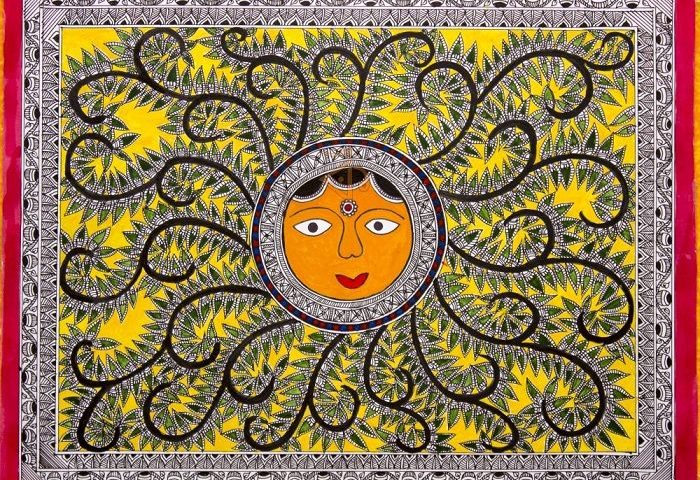
India is a country overflowing with various forms of art, each one unique and requires mastery on its own terms. One such artform is Madhubani art and its paintings. Originating in the Mithila region of Bihar, some of the initial references to the Madhubani painting can be found in the Hindu epic Ramayana when King Janaka, Sita’s father, asks his painters to create Madhubani paintings for his daughter’s wedding.
The knowledge of the art was passed down from generation to generation of painters and the paintings began to adorn the houses of the region and became commonplace. The women of the village practised these paintings on the mud walls of their huts and homes. Their paintings often illustrated their thoughts, hopes, and dreams.
Throughout history, Madhubani paintings have been a part of festivities and special events like weddings. Slowly, it attracted connoisseurs of art as many contemporary Indian artists took the art onto the global stage. The traditional base of plastered mud wall was soon replaced handmade paper, cloth, and canvas. Since the art had originated and was confined to a particular region, the themes and the styles of the art remain the same.

Often characterized complex geometrical patterns, the colours used in Madhubani paintings are usually derived from plants and other natural sources. These colours are often bright and pigments like lampblack and ochre are used to create black and brown respectively. Instead of contemporary brushes, objects like twigs, matchsticks, and even fingers are used to create the paintings.
Madhubani art was initially practised different sects of people such as Tantrik, Kohbar, Bharni, Godna, Katchni. But today, these five different styles have been merged contemporary artists. These paintings are also known for their simplicity, for the brush and colours used are often derived from natural sources. The paintings are largely made using powdered rice, colours derived from turmeric, pollen, pigments, indigo, various flowers, sandalwood, and leaves of various plants and trees, etc.
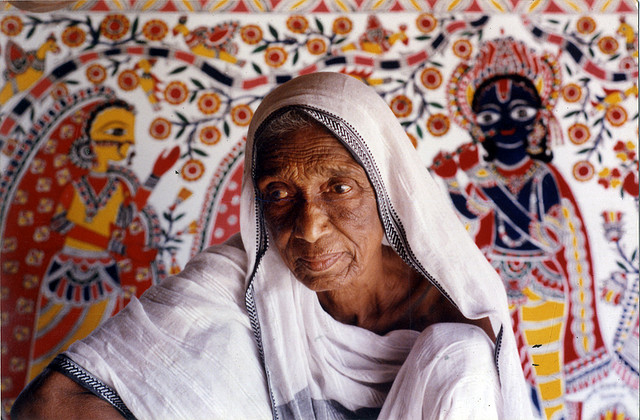
Madhubani art received official recognition in 1969 when Sita Devi received the State award Government of Bihar. In 1975, President of India gave the Padma Shri award to Jagdamba Devi and the National Award to Sita Devi of Jitwarpur village near Madhubani. Sita Devi was also awarded Bihar Ratna in 1984 and Shilp Guru in 2006.
In 2012, more than 100 trees were decorated using Madhubani painting. Shashthi Nath Jha, who runs the Gram Vikas Parishad, an NGO, started the initiative as an attempt to protect trees that were being cut down in the name of expanding roads and development. This proved to be an effective way to make the villagers aware of its consequences like climate change and global warming.
Madhubani art is truly a heritage to be protected, preserved and revered and is valuable to the culture and tradition of our country.